
Telecomm. Degree
Bachelor’s Thesis (TFG) – Deep Learning for Skin Lesion Analysis
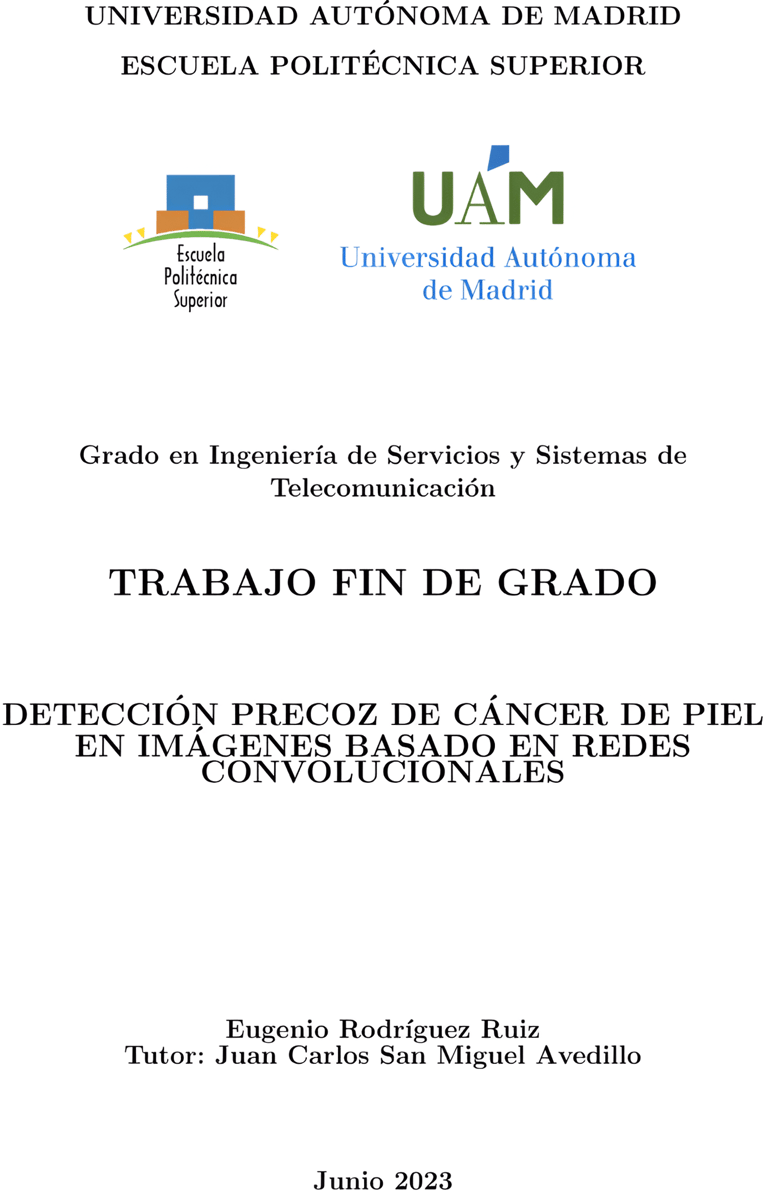
The goal of my thesis was to analyze dermoscopic images of skin lesions and determine whether they were malignant or benign using artificial intelligence. I worked with the ISIC (International Skin Imaging Collaboration) dataset and carried out a comparative study of different Deep Learning architectures, adapting them to the dataset after an in-depth review of the scientific literature.
This project required handling a large volume of medical images and ensuring the models could generalize effectively. Some of the main challenges I faced were:
Interpreted and applied insights from scientific papers.
Conducted independent research to select and adapt suitable architectures.
Managed class imbalance in the dataset (benign vs. malignant).
Implemented strategies such as data augmentation and class-weight balancing to mitigate bias.
Applied transfer learning to leverage pretrained Convolutional Neural Networks (CNNs).
The thesis not only strengthened my technical skills but also honed my ability to research, problem-solve, and apply AI to real-world medical challenges.

Description
Technologies
Python
os, PIL, Numpy, Pandas, Matplotlib
Sklearn, TensorFlow, Keras
Handling datasets
Data Augmentation
Transfer Learning
Other Interesting Projects
Handwritten Digit Classification using Suport Vector Machines
This two-month project, developed in a team of four, focused on analyzing and classifying handwritten digit images with Support Vector Machines (SVM). The goal was to study the technology in depth and implement a Python solution that met all requirements, including detailed research, multiple experiments, critical design decisions, and the presentation of results.
Challenges faced:
Coordinating effectively within the team without direct guidance from the professor.
Managing version control through GitHub to ensure code traceability and collaboration.
Conducting independent research on SVMs and their practical application.
Balancing theory and implementation within a limited timeframe.
Scene Recognition with Convolutional Neural Networks
This project, developed in Python, focused on scene recognition using images from a dataset containing various environments (parks, kitchens, streets, etc.). The aim was to evaluate how performance varied depending on different parameters, including network architecture, image resolution, filter size, number of layers, and activation functions. The work concluded with a detailed report of results.
Challenges faced:
Experimenting with multiple CNN configurations to understand their impact on accuracy.
Selecting the most suitable architectures under time and resource constraints.
Synthesizing findings into a comprehensive and well-structured report.
Present the report to the teacher, explaining the findings
Technologies: Python, CNNs, TensorFlow
Technologies: Python, SVM, GitHub